 Add to Chrome
 Add to Firefox
 Add to Edge
X-Stream: Exploring MLLMs as Multiplexers for Multi-Stream Understanding
Jun 01, 2026
While video streaming understanding has made significant strides, real-world applications, such as live sports broadcasting, autonomous driving, and multi-screen collaboration, inherently demand continuous, multi-stream interactions. However, existing benchmarks are confined to single-stream paradigms, leaving a critical gap in evaluating online, cross-stream reasoning. To bridge this, we introduce X-Stream, the first benchmark dedicated to multi-stream streaming understanding. Comprising 4,220 rigorously curated QA pairs across 932 videos, X-Stream evaluates 11 subtasks across multi-window, multi-view, and multi-device scenarios. Crucially, our dataset is constructed using a novel dual-verification pipeline that prevents over-reliance on a single stream. Furthermore, we pioneer the conceptualization of multi-modal large language models (MLLMs) as naive multiplexers, systematically evaluating their performance through the lens of Signal Multiplexing Theory. Our extensive online inference experiments reveal a stark reality: state-of-the-art MLLMs struggle significantly with concurrent streams, achieving only about 50% score and exhibiting poor proactive ability. Ultimately, X-Stream exposes the trade-off of current multiplexing schemes, providing both a practical evaluation protocol and empirical guidance for next-generation multi-stream agents.

UI-KOBE: Knowledge-Oriented Behavior Exploration for Lightweight Graph-Guided GUI Agents
May 28, 2026Recent advances in mobile GUI agents have shown strong potential for automating mobile tasks, but most effective systems still depend on large vision-language models for screenshot understanding and long-horizon planning. Small GUI agents that can be deployed directly on mobile devices are more attractive for practical use, offering lower inference cost and better protection of sensitive on-device information. However, due to limited model capacity, such lightweight agents remain unreliable when planning and executing GUI tasks end-to-end from screenshots alone. We propose Knowledge-Oriented Behavior Exploration (\textbf{UI-KOBE}), a framework that improves lightweight mobile GUI agents with reusable app-specific graph knowledge. UI-KOBE first autonomously explores a mobile application and constructs an app knowledge graph, where nodes represent distinct UI states and edges represent executable transitions. At runtime, a lightweight GUI agent uses the graph as external guidance: given a user task and the current screenshot, it identifies the current graph node and selects among self-loop actions, neighboring transitions, task completion, or fallback free actions associated with that node. By supporting runtime decisions with app-specific graph guidance, UI-KOBE reduces the burden of end-to-end GUI planning and helps lightweight models perform mobile GUI tasks more effectively, offering a practical step toward efficient, interpretable, and privacy-conscious on-device GUI agents.
OmniInteract: Benchmarking Real-World Streaming Interaction for Real-Time Omnimodal Assistants
May 26, 2026We introduce OmniInteract, a streaming benchmark for real-time omnimodal large language models evaluated through native online inference over audio-visual streams. Unlike offline video understanding or text-prompted streaming QA, OmniInteract preserves the original audio-visual stream and requires models to process it online, without access to future content. User queries and ambient sounds are embedded in the audio track, requiring models to detect multimodal triggers, decide when to respond, and answer while the stream unfolds. OmniInteract contains 250 videos with 1,430 temporally grounded response slots: 1,062 1Q1A slots across real-time, proactive, and nested scenarios, and 368 1QnA slots for continuous task monitoring and step guidance. Each slot includes a trigger, response window, and target answer. We evaluate response correctness, timing, invalid outputs, interruption handling, and context continuity using Interaction-Aware Quality-Timeliness F1, Interruption Diagnostic Suite, and Nested Chain Completion Score. Experiments show that current models remain weak in streaming interaction, with the best overall IA-QTF1 reaching only 0.368 and the best 1QnA IA-QTF1 only 0.052. Further study on mathematical reasoning in full-duplex settings shows that offline capability does not necessarily transfer to online interaction. Code and datasets will be made publicly accessible at https://github.com/Lucky-Lance/OmniInteract.
See the Forest for the Trees: Loosely Speculative Decoding via Visual-Semantic Guidance for Efficient Inference of Video LLMs
Apr 07, 2026Video Large Language Models (Video-LLMs) excel in video understanding but suffer from high inference latency during autoregressive generation. Speculative Decoding (SD) mitigates this by applying a draft-and-verify paradigm, yet existing methods are constrained by rigid exact-match rules, severely limiting the acceleration potential. To bridge this gap, we propose LVSpec, the first training-free loosely SD framework tailored for Video-LLMs. Grounded in the insight that generation is governed by sparse visual-relevant anchors (mandating strictness) amidst abundant visual-irrelevant fillers (permitting loose verification), LVSpec employs a lightweight visual-relevant token identification scheme to accurately pinpoint the former. To further maximize acceptance, we augment this with a position-shift tolerant mechanism that effectively salvages positionally mismatched but semantically equivalent tokens. Experiments demonstrate that LVSpec achieves high fidelity and speed: it preserves >99.8 of target performance while accelerating Qwen2.5-VL-32B by 2.70x and LLaVA-OneVision-72B by 2.94x. Notably, it boosts the mean accepted length and speedup ratio by 136% and 35% compared to SOTA training-free SD methods for Video-LLMs.
AURA: Always-On Understanding and Real-Time Assistance via Video Streams
Apr 05, 2026Video Large Language Models (VideoLLMs) have achieved strong performance on many video understanding tasks, but most existing systems remain offline and are not well-suited for live video streams that require continuous observation and timely response. Recent streaming VideoLLMs have made progress, yet current approaches often rely on decoupled trigger-response pipelines or are limited to captioning-style narration, reducing their effectiveness for open-ended question answering and long-horizon interaction. We propose AURA (Always-On Understanding and Real-Time Assistance), an end-to-end streaming visual interaction framework that enables a unified VideoLLM to continuously process video streams and support both real-time question answering and proactive responses. AURA integrates context management, data construction, training objectives, and deployment optimization for stable long-horizon streaming interaction. It achieves state-of-the-art performance on streaming benchmarks and supports a real-time demo system with ASR and TTS running at 2 FPS on two 80G accelerators. We release the AURA model together with a real-time inference framework to facilitate future research.
CoVe: Training Interactive Tool-Use Agents via Constraint-Guided Verification
Mar 02, 2026Developing multi-turn interactive tool-use agents is challenging because real-world user needs are often complex and ambiguous, yet agents must execute deterministic actions to satisfy them. To address this gap, we introduce \textbf{CoVe} (\textbf{Co}nstraint-\textbf{Ve}rification), a post-training data synthesis framework designed for training interactive tool-use agents while ensuring both data complexity and correctness. CoVe begins by defining explicit task constraints, which serve a dual role: they guide the generation of complex trajectories and act as deterministic verifiers for assessing trajectory quality. This enables the creation of high-quality training trajectories for supervised fine-tuning (SFT) and the derivation of accurate reward signals for reinforcement learning (RL). Our evaluation on the challenging $τ^2$-bench benchmark demonstrates the effectiveness of the framework. Notably, our compact \textbf{CoVe-4B} model achieves success rates of 43.0\% and 59.4\% in the Airline and Retail domains, respectively; its overall performance significantly outperforms strong baselines of similar scale and remains competitive with models up to $17\times$ its size. These results indicate that CoVe provides an effective and efficient pathway for synthesizing training data for state-of-the-art interactive tool-use agents. To support future research, we open-source our code, trained model, and the full set of 12K high-quality trajectories used for training.
PhoStream: Benchmarking Real-World Streaming for Omnimodal Assistants in Mobile Scenarios
Jan 30, 2026Multimodal Large Language Models excel at offline audio-visual understanding, but their ability to serve as mobile assistants in continuous real-world streams remains underexplored. In daily phone use, mobile assistants must track streaming audio-visual inputs and respond at the right time, yet existing benchmarks are often restricted to multiple-choice questions or use shorter videos. In this paper, we introduce PhoStream, the first mobile-centric streaming benchmark that unifies on-screen and off-screen scenarios to evaluate video, audio, and temporal reasoning. PhoStream contains 5,572 open-ended QA pairs from 578 videos across 4 scenarios and 10 capabilities. We build it with an Automated Generative Pipeline backed by rigorous human verification, and evaluate models using a realistic Online Inference Pipeline and LLM-as-a-Judge evaluation for open-ended responses. Experiments reveal a temporal asymmetry in LLM-judged scores (0-100): models perform well on Instant and Backward tasks (Gemini 3 Pro exceeds 80), but drop sharply on Forward tasks (16.40), largely due to early responses before the required visual and audio cues appear. This highlights a fundamental limitation: current MLLMs struggle to decide when to speak, not just what to say. Code and datasets used in this work will be made publicly accessible at https://github.com/Lucky-Lance/PhoStream.
VP-Bench: A Comprehensive Benchmark for Visual Prompting in Multimodal Large Language Models
Nov 14, 2025Multimodal large language models (MLLMs) have enabled a wide range of advanced vision-language applications, including fine-grained object recognition and contextual understanding. When querying specific regions or objects in an image, human users naturally use "visual prompts" (VPs), such as bounding boxes, to provide reference. However, no existing benchmark systematically evaluates the ability of MLLMs to interpret such VPs. This gap leaves it unclear whether current MLLMs can effectively recognize VPs, an intuitive prompting method for humans, and use them to solve problems. To address this limitation, we introduce VP-Bench, a benchmark for assessing MLLMs' capability in VP perception and utilization. VP-Bench employs a two-stage evaluation framework: Stage 1 examines models' ability to perceive VPs in natural scenes, using 30k visualized prompts spanning eight shapes and 355 attribute combinations. Stage 2 investigates the impact of VPs on downstream tasks, measuring their effectiveness in real-world problem-solving scenarios. Using VP-Bench, we evaluate 28 MLLMs, including proprietary systems (e.g., GPT-4o) and open-source models (e.g., InternVL3 and Qwen2.5-VL), and provide a comprehensive analysis of factors that affect VP understanding, such as variations in VP attributes, question arrangement, and model scale. VP-Bench establishes a new reference framework for studying how MLLMs comprehend and resolve grounded referring questions.
From Exploration to Exploitation: A Two-Stage Entropy RLVR Approach for Noise-Tolerant MLLM Training
Nov 11, 2025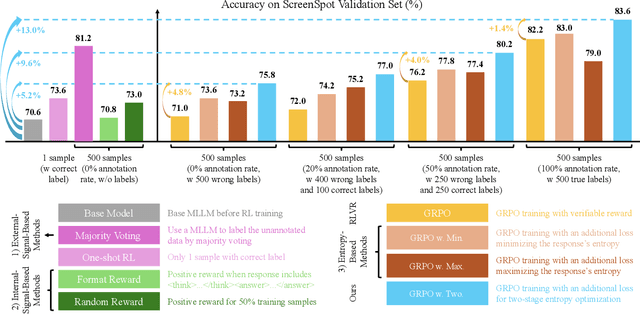

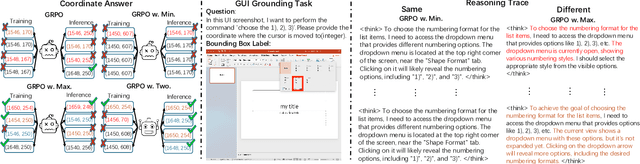

Reinforcement Learning with Verifiable Rewards (RLVR) for Multimodal Large Language Models (MLLMs) is highly dependent on high-quality labeled data, which is often scarce and prone to substantial annotation noise in real-world scenarios. Existing unsupervised RLVR methods, including pure entropy minimization, can overfit to incorrect labels and limit the crucial reward ranking signal for Group-Relative Policy Optimization (GRPO). To address these challenges and enhance noise tolerance, we propose a novel two-stage, token-level entropy optimization method for RLVR. This approach dynamically guides the model from exploration to exploitation during training. In the initial exploration phase, token-level entropy maximization promotes diverse and stochastic output generation, serving as a strong regularizer that prevents premature convergence to noisy labels and ensures sufficient intra-group variation, which enables more reliable reward gradient estimation in GRPO. As training progresses, the method transitions into the exploitation phase, where token-level entropy minimization encourages the model to produce confident and deterministic outputs, thereby consolidating acquired knowledge and refining prediction accuracy. Empirically, across three MLLM backbones - Qwen2-VL-2B, Qwen2-VL-7B, and Qwen2.5-VL-3B - spanning diverse noise settings and multiple tasks, our phased strategy consistently outperforms prior approaches by unifying and enhancing external, internal, and entropy-based methods, delivering robust and superior performance across the board.
SEFE: Superficial and Essential Forgetting Eliminator for Multimodal Continual Instruction Tuning
May 05, 2025Multimodal Continual Instruction Tuning (MCIT) aims to enable Multimodal Large Language Models (MLLMs) to incrementally learn new tasks without catastrophic forgetting. In this paper, we explore forgetting in this context, categorizing it into superficial forgetting and essential forgetting. Superficial forgetting refers to cases where the model's knowledge may not be genuinely lost, but its responses to previous tasks deviate from expected formats due to the influence of subsequent tasks' answer styles, making the results unusable. By contrast, essential forgetting refers to situations where the model provides correctly formatted but factually inaccurate answers, indicating a true loss of knowledge. Assessing essential forgetting necessitates addressing superficial forgetting first, as severe superficial forgetting can obscure the model's knowledge state. Hence, we first introduce the Answer Style Diversification (ASD) paradigm, which defines a standardized process for transforming data styles across different tasks, unifying their training sets into similarly diversified styles to prevent superficial forgetting caused by style shifts. Building on this, we propose RegLoRA to mitigate essential forgetting. RegLoRA stabilizes key parameters where prior knowledge is primarily stored by applying regularization, enabling the model to retain existing competencies. Experimental results demonstrate that our overall method, SEFE, achieves state-of-the-art performance.